Working Pressure
Working pressure varies according to coupling size and material used, and is generally up to two-thirds of the maximum test pressure shown in the applicable schedules of dimensions.
Working Pressure
Working pressure varies according to coupling size and material used, and is generally up to two-thirds of the maximum test pressure shown in the applicable schedules of dimensions.
Pressure Ratings and Pipeline Forces
This varies with coupling size and material used. Generally, working pressure is up to 2/3rds of the maximum test pressure shown in the schedules of dimensions in our catalogue. Couplings are pressure rated to appropriate pipe standards in common use. For higher pressures, special couplings can be supplied.
KLAMFLEX Couplings and Flange adaptors for cast iron mains, carrying water, sewage or gas, are suitable for the pressures for which the pipes are normally supplied. Generally, flange adaptors are suitable for the pressure ratings of the flange to which they are connected. The pressure ratings stated in this catalogue are hydrostatic test pressures.
Expansion and Contraction
Pipelines under pressure are subject to forces which tend to separate the component parts. Flexible pipelines, e.g. those jointed with KLAMFLEX Couplings, are particularly subject to forces acting at bends, tees or blank ends.
Buried pipelines can generally be restrained by means of anchor blocks at abrupt changes of direction, with the minor forces at each straight joint being restrained by soil friction.
With above-ground pipelines, it is necessary to take full account of the thrusts produced by internal pressure and, where required, to restrain them with thrust blocks, anchorage or tie bars.
End Thrust at a Blank End
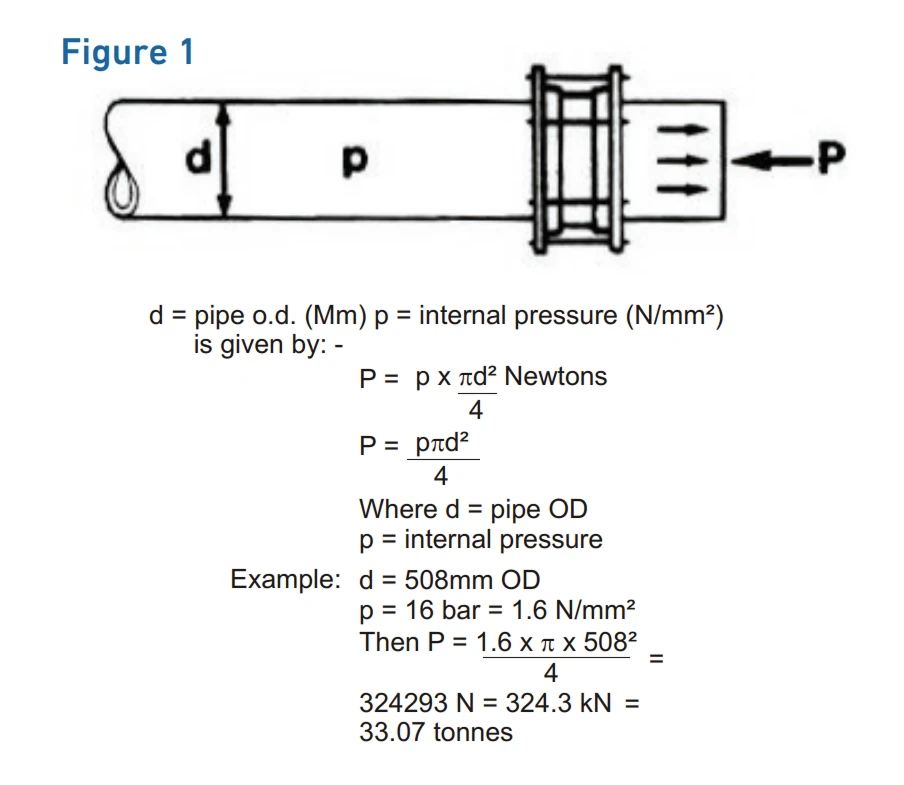
In the simple case of pressure acting on a blank end, the force P necessary to prevent pipe separation is given by Figure 1.
End Thrust at a Bend
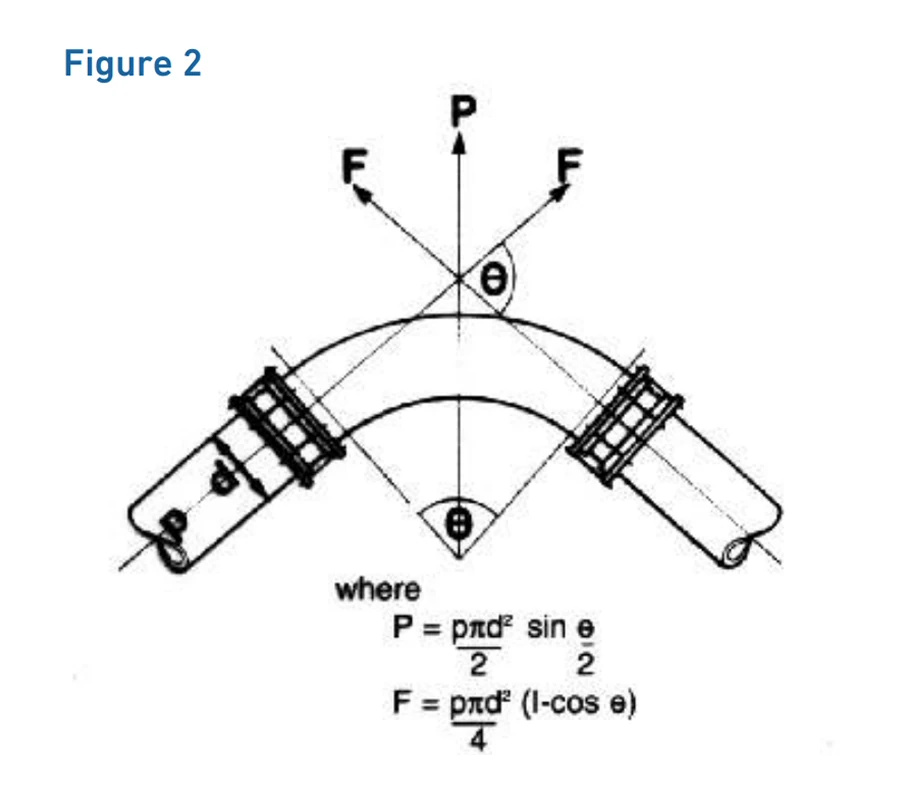
At a bend, a force F tends to pull the end outwards, resulting in axial forces that can act to separate the bend from the straight pipe at each KLAMFLEX coupling, as shown in Figure 2 below.
Important: End Thrust
IT IS IMPORTANT TO APPRECIATE THE MAGNITUDE OF THE END THRUSTS WHICH CAN RESULT FROM INTERNAL PRESSURE IN A PIPELINE